
Advantage of portable ultrasonic spot welding machines
In modern industrial production and daily maintenance scenarios, the demand for flexibility and precision in welding processes is increasing day by day. Traditional fixed welding equipment is limited by the site and the size of the workpiece, making it difficult to meet the immediate welding requirements in complex environments. The portable ultrasonic spot welding machine, with its portable design, efficient welding and precise control features, has become a “mobile welding expert” in fields such as electronics, automobiles, home appliances and medical care, providing innovative solutions for diverse welding scenarios
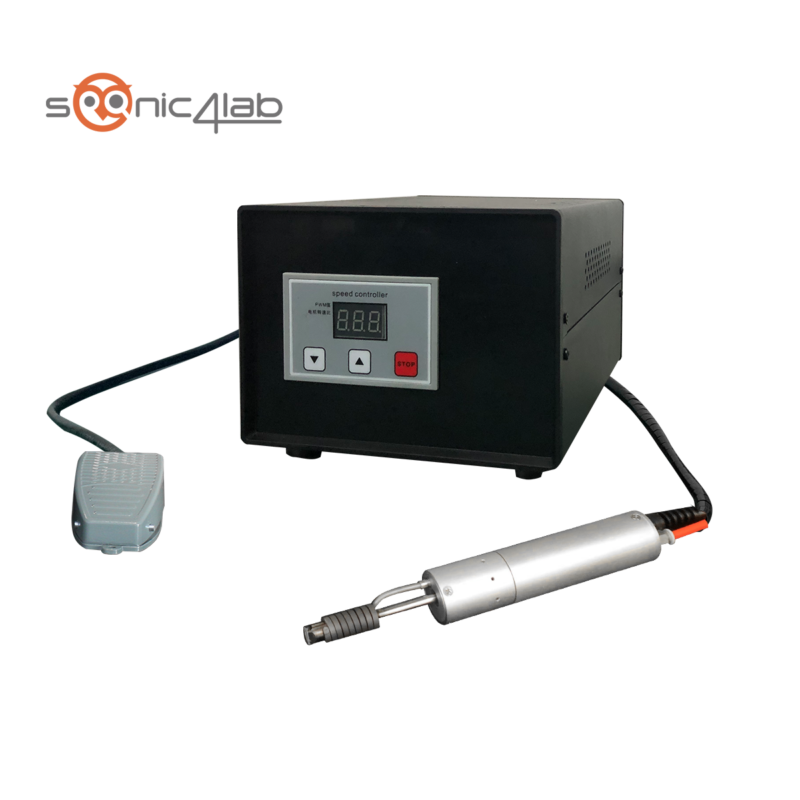
Core advantages:
1.Flexible movement, breaking through scene limitations
Traditional fixed welding machines require the workpiece to accommodate the equipment, while portable spot welding machines can work close to the workpiece anytime and anywhere. In car maintenance, on-site welding can be directly carried out on plastic parts inside the vehicle (such as dashboard cracks and bumper clips) without disassembling the parts, saving more than 50% of the maintenance time. In outdoor advertising installation, LED light strip brackets and acrylic board splicing points can be quickly welded to meet the urgent construction needs.
- Precise spot welding, minimally invasive and traceless process
Ultrasonic spot welding achieves material melting through local high-frequency vibration. The minimum diameter of the weld point can reach 2mm, and the heat-affected zone is only 0.5-1mm, avoiding the large-area heating damage caused by traditional hot melting processes. In the repair of electronic components, the flexible circuit board on the mobile phone mainboard can be precisely soldered. The position error of the solder joint is ≤±0.2mm, and it does not affect the performance of the surrounding components. In the customization of high-end clothing, seamless spot welding can be performed on fine fabrics such as lace and silk, replacing traditional needles and threads to maintain the aesthetic appeal of the fabrics.
- High efficiency and energy saving, welding immediately upon startup
The equipment adopts instantaneous start-up technology. It can reach the rated power within 1 second after being turned on. The energy consumption for a single soldering is only 0.1-0.5Wh, which is more than 70% more energy-efficient than traditional soldering irons. In mass production scenarios, handheld devices can be used in conjunction with assembly line operations to achieve “soldering as you go”. For instance, on a small electronic component assembly line, a single worker can complete 20 to 30 solder joints per minute, with efficiency comparable to that of semi-automatic equipment.
With the deepening demands for portability and intelligence, portable ultrasonic spot welding machines will develop in the following directions:
- Wireless and lithium battery: Develop wireless models with built-in lithium batteries, free from the constraints of power cords, with a battery life of 4 to 6 hours, suitable for outdoor scenarios without power supply;
- Artificial Intelligence Assisted Welding: Integrating micro cameras and machine learning algorithms, it automatically identifies the material of the workpiece and the welding position, recommends the best welding parameters, and reduces the reliance on the operator’s experience;
- Multi-functional modularization: The design features replaceable welding head modules (such as spot welding heads, seam welding heads, and cutting heads) to achieve “one machine with multiple uses”. For instance, by replacing the cutting head, the cutting and edge sealing of plastic parts can be completed simultaneously.
In the future, with the continuous iteration of technology, this “Welding expert in your pocket” will continue to expand its application boundaries, making every welding operation a model of flexibility and precision, and injecting more innovative possibilities into the manufacturing and life service sectors.