
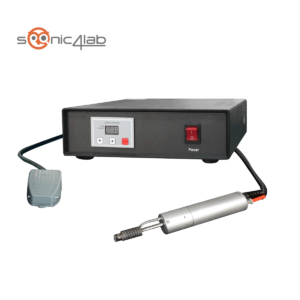
Ultrasonic textile fabric welding machine
1. Technical Principles
In the wave of transformation towards intelligence and efficiency in the textile and garment industry, the limitations of traditional needle and thread sewing have become increasingly prominent – problems such as needle hole leakage, thread end detachment, and deformation of elastic fabrics have always been plaguing the industry’s upgrading. Ultrasonic fabric welding machines, with their technological breakthroughs in needle-free sewing and high-frequency hot melting, are reshaping the process logic of textile manufacturing, bringing about all-round innovations in production efficiency and product performance to fields such as clothing, medical care, and outdoor products.
2.Core Advantages
(1) Seamless welding, performance leap
Traditional needle and thread sewing leaves pinholes, while the seamless feature of ultrasonic welding has significant advantages in terms of water resistance and wind resistance. Data shows that the water pressure resistance value of the seams of its welded down jackets reaches 20,000 MMH ₂O, which is four times that of traditional needle and thread sewing (5,000 MMH ₂O), meeting the requirements of outdoor equipment. In addition, the welding surface is smooth and non-irritating, making it suitable for scenarios such as baby clothing and medical bandages.
(2) Efficient production, doubling capacity
The continuous operation mode of ultrasonic welding far exceeds that of traditional sewing machines. Take sportswear production as an example. Traditional sewing machines can sew 10 to 15 meters per minute, while ultrasonic welding machines combined with conveyor belts can reach 30 to 50 meters, increasing production capacity by 2 to 3 times. After the introduction of a certain brand, the daily output of summer T-shirts increased from 8,000 pieces to 15,000 pieces, and the delivery cycle was shortened by 40%.
(3) Compatible fabrics and flexible manufacturing processes
The equipment is compatible with a variety of fabrics:
- Elastic fabric: The elastic recovery rate of spandex for swimsuits after welding exceeds 85%, avoiding stretching deformation.
- Multi-layer composite fabric: The waterproof film and fabric of the windbreaker can be formed at one time, increasing production efficiency by 60%.
- Special functional fabrics: The antibacterial rate of medical antibacterial fabrics still exceeds 99% after welding.
(4) Environmental protection and energy conservation, green manufacturing
Ultrasonic welding does not require needles and threads. Medium-sized factories can save 3 to 5 tons of materials annually. No glue used, zero VOCs emissions; The energy consumption is 50% lower than that of hot air welding, with a power consumption of 1.5-2.5kW · h per hour, which is in line with the trend of carbon neutrality.
3.Application Scenarios
(1)Outdoor sports equipment
- Windbreakers and tents: The seamless seams welded by ultrasonic waves completely prevent rainwater leakage. After a well-known outdoor brand adopted this technology, the complaint rate of water leakage in extreme weather tests decreased by 92%.
- Mountaineering backpack: The welded part between the shoulder strap and the bag body can bear a load of up to 30kg, which is twice as much as the traditional needle and thread sewing (15kg), meeting the professional mountaineering needs.
(2) Medical and health field
- Surgical gowns and protective suits: Special equipment for aseptic workshops can weld PP+PE composite non-woven fabric to form a sealed antibacterial layer, with a virus filtration efficiency of up to 99.99%.
- Medical bandage: The elastic bandage has a tensile strength of 18N/cm after welding, and the edge has no burrs, avoiding secondary damage to the wound.
(3) Industry and special fields
- Automotive airbags: The welding speed reaches 0.5 seconds per piece, meeting the strength requirements when airbags deploy at high speed (bursting pressure > 500kPa);
- Aerospace fabric: The ultra-thin polyester film of the satellite sunshade sail has a welding error of less than 0.1mm, ensuring structural stability under extreme temperature differences.
With the continuous decline in technical costs (the equipment price has dropped by 40% compared to five years ago), ultrasonic fabric welding machines have moved from high-end brands to the mass market