
Ultrasonic Soldering Iron in Sensor Soldering
The application value of ultrasonic soldering iron in sensor soldering – Sonic4lab
In the fields of industrial testing, intelligent devices, aerospace, etc., sensors are the core components for data acquisition, and their welding quality directly determines the measurement accuracy and service life. Ultrasonic soldering iron combines the high-temperature heating and ultrasonic vibration technology of traditional soldering iron. With its unique welding characteristics, it has become an ideal tool for welding various types of sensors such as stress, strain, and temperature, providing efficient and reliable connection solutions for sensor manufacturing.

The core advantage of ultrasonic soldering iron comes from the working principle of “thermal shock synergy”. The internally integrated ultrasonic generator converts electrical energy into high-frequency mechanical vibration, forming a synergistic effect with the high temperature generated by the heating element: high temperature melts the solder, while the 20-40kHz high-frequency vibration can destroy the oxide layer on the surface of the solder, promote the spreading and penetration of the solder between the sensor pin and the substrate, and form a dense metal bonding layer. This feature solves the problems of virtual soldering and porosity that are prone to occur during traditional soldering with an electric iron, especially suitable for the soldering needs of precision components such as sensors.
For stress and strain sensors, thermal deformation during welding is a key hazard that affects measurement accuracy. The sensitive components of such sensors are mostly metal foils or semiconductor materials, which are extremely sensitive to temperature changes. The short-term heating characteristics of ultrasonic soldering iron can reduce the heat affected zone of the welding area to within 0.5 millimeters, avoiding changes in the metallographic structure of sensitive components due to prolonged high temperature. At the same time, its vibration assisted welding can reduce the amount of solder used, lower the mechanical stress at the welding point, ensure the stability of signal transmission of the sensor during force deformation, and control the measurement error within 0.1%.
The welding core requirement of temperature sensors is a balance between thermal conductivity and sealing, especially for sensors working in high temperature environments, where the welding points need to withstand long-term thermal cycling impacts. The solder layer formed by ultrasonic soldering iron has fine grains, and the thermal conductivity is increased by more than 30% compared to traditional soldering, which can quickly transmit temperature signals from sensors. For common temperature sensors such as platinum resistors and thermocouples, it can accurately control the melting range of solder, avoid solder overflow covering the temperature sensing area, and effectively improve the interface bonding strength in heterogeneous welding between ceramic substrates and metal pins, meeting the wide temperature working requirements of -50 ℃ to 800 ℃.
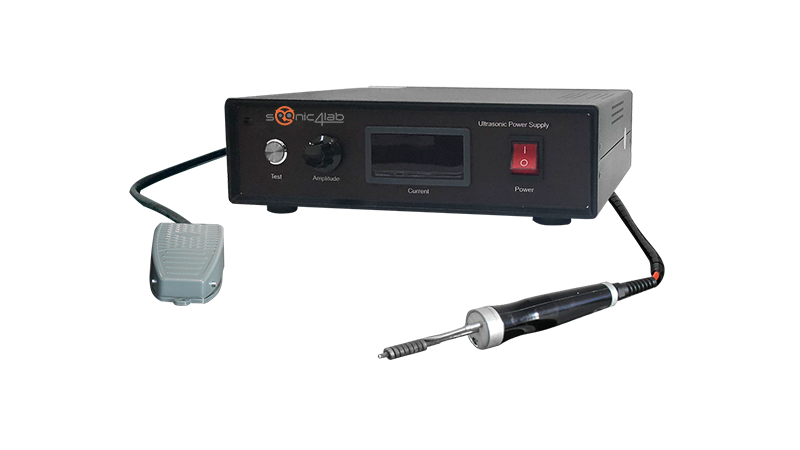
Pressure sensors often adopt a microstructure design, with internal pin spacing of only 0.3-0.5 millimeters, and traditional soldering is prone to bridging short circuits. The ultra-fine tip diameter of the ultrasonic soldering iron can be as low as 0.1 millimeters, and combined with the directional energy transfer of high-frequency vibration, it can achieve precise positioning and filling of solder. In the welding of strain gauge pressure sensors, it can ensure that the solder evenly covers the pins, while avoiding damage to the strain beam of the sensor core caused by vibration energy, ensuring the measurement stability of the sensor in high-pressure environments.
The welding of infrared and radiation sensors requires extremely high cleanliness, and impurities in the solder can seriously affect optical signal transmission. The vibration effect of ultrasonic soldering iron can achieve self-cleaning effect during the welding process, remove oil and oxide impurities on the surface of the solder pad, and reduce the oxide content in the solder. For the soldering of photosensitive components and metal pins in infrared sensors, the low-temperature soldering mode (180-220 ℃) can avoid the performance damage of photosensitive materials caused by high temperatures. In the sealing soldering of radiation sensors, a seamless solder layer can be formed to prevent radiation particle leakage from affecting measurement accuracy.
In the mass production of sensors, the efficient characteristics of ultrasonic soldering irons are also highlighted. Its welding cycle is 40% shorter than traditional soldering irons, and there is no need to add additional flux, reducing the subsequent cleaning process. At the same time, stable welding quality reduces the rework rate of sensors, especially in fields such as automotive electronics and medical equipment that require strict reliability of sensors, providing strong guarantees for product quality. With the development of sensor technology towards miniaturization and high precision, ultrasonic soldering irons, with their unique technological advantages, will undoubtedly play a core role in the manufacturing of more types of sensors.
If you want to purchase equipment, please click here.
