
Ultrasonic Soldering and Active Solders
Ultrasonic Soldering and Active Solders – Sonic4Lab
In the field of welding in industrial manufacturing, traditional processes have long relied on chemical fluxes to complete the core joining process. The core mechanism lies in the active components of the chemical flux removing the oxide layer on the surface of the molten filler metal and the base metal—this oxide layer is a key barrier preventing effective bonding between metals. Once the oxide layer is successfully removed, the molten filler metal can smoothly wet the base metal surface, and then, through cooling and solidification, form a stable metallurgical bond, ensuring the structural strength and electrical and thermal conductivity of the welded joint. This process, due to its relatively simple operation and controllable cost, has been widely used in many industries such as electronic component assembly, automotive parts manufacturing, and hardware processing.
However, the inherent defects of chemical fluxes remain a fatal weakness restricting the long-term reliability of welded products. As a highly corrosive chemical substance, flux cannot completely volatilize or decompose during the welding process, and residual components continue to adhere to the weld interface and surrounding areas. The harm of this residual corrosion is not immediately apparent, but rather exhibits a long-term, latent, and gradually aggravating characteristic. In precision electronic equipment, even trace amounts of flux residue can trigger electrochemical corrosion of circuit board metal leads, leading to poor contact, short circuits, or even equipment downtime. This corrosion rate accelerates significantly in harsh environments with high temperature, high humidity, or high salt spray, drastically shortening product lifespan. In fields with extremely high structural safety requirements, such as automotive and aerospace, residual corrosion at welded joints gradually weakens connection strength, potentially causing component failure and leading to serious safety accidents. Furthermore, flux residue can affect the effectiveness of subsequent coating and electroplating processes, causing coating peeling, uneven plating, and other problems, increasing rework costs and quality risks. For high-end manufacturing sectors that demand high reliability and long service life, the corrosion hazards posed by chemical fluxes have become a pressing industry pain point.
To address the core drawbacks of traditional processes, a new fluxless welding technology has emerged, eliminating reliance on corrosive chemical fluxes at their source and providing a revolutionary process solution for improving the reliability of welded products. This technology, through innovative energy transfer and interface cleaning mechanisms, achieves efficient removal of oxide layers from metal surfaces and the formation of a stable metallurgical bond without the need for chemical substances, completely avoiding the risk of residual corrosion.
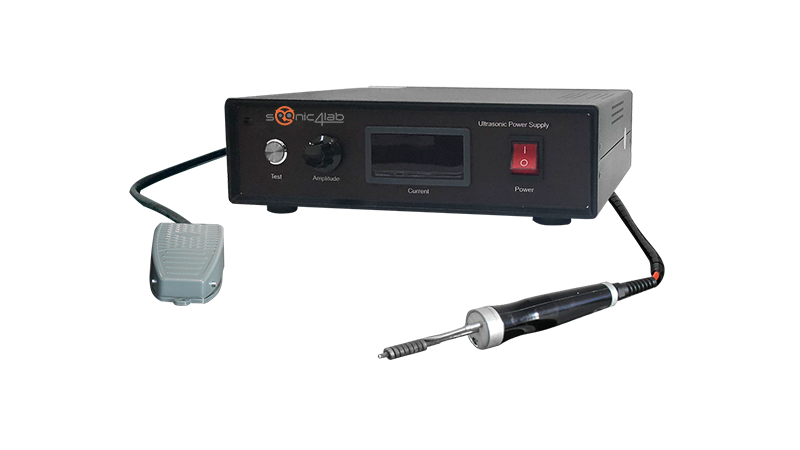
Its core process mechanism revolves around the synergistic effect of a specialized heating probe and high-frequency vibration. The technology employs a specially designed heating probe with a tip that allows for precise temperature control, ensuring stable melting of the filler metal in a designated area. Simultaneously, the probe vibrates at a high frequency of 20-60kHz, and the acoustic energy generated by this vibration is precisely transferred to the molten filler metal through the probe tip. Notably, the specially designed probe tip possesses acoustic energy focusing capabilities, concentrating the dispersed vibrational energy onto the welding interface, inducing a strong cavitation effect within the molten filler metal—the formation, growth, and collapse of bubbles in a liquid.
In this process, the molten filler metal not only serves as the core material for achieving the bond but also acts as an efficient medium for transmitting ultrasonic energy, ensuring that the acoustic energy is precisely applied to the oxide layer interface. When the microbubbles induced by high-frequency vibration grow and eventually collapse at the interface between the molten metal and the base metal, they generate instantaneous strong impact forces and localized high temperatures. This physical process efficiently peels off and decomposes the oxide layer on the surface of the molten filler metal and the base metal, thoroughly removing impurities that hinder metal bonding. More importantly, after the oxide layer is removed, the exposed clean, oxide-free metal surface immediately wets and metallurgically bonds with the surrounding molten filler metal. This entire process is completed almost simultaneously, effectively preventing the clean metal surface from being re-oxidized in the air, thus forming a weld joint with high bonding strength, good stability, and no corrosion risks.
Compared to traditional chemical flux welding processes, this fluxless welding technology not only fundamentally solves the long-standing problem of residual corrosion in the industry, improving product reliability and lifespan, but also has wider applicability. It can be adapted to welding various metal materials, including some dissimilar metal connections that are difficult to handle with traditional processes, while reducing the environmental pressure and subsequent cleaning costs associated with chemical flux use. In fields with stringent requirements for welding quality and reliability, such as precision electronics manufacturing, high-end equipment manufacturing, and aerospace, this technology is gradually becoming a core solution to replace traditional processes, driving the welding industry towards greater efficiency, reliability, and environmental friendliness.
If you want to purchase equipment, please click here.

