
Cracking the Bottleneck of Aluminum-Copper Composite Radiators
Cracking the Bottleneck of Aluminum-Copper Composite Radiators
In the radiator industry, balancing performance and cost is a perennial challenge. The composite structure of “aluminum fins + copper base” has become the mainstream choice. The copper base, with its excellent thermal conductivity, quickly conducts heat from the heat source, while the aluminum fins improve heat dissipation efficiency due to their low cost and lightweight design, making it widely suitable for various scenarios such as automobiles and electronic devices. However, the connection between dissimilar metals like aluminum and copper has long been a core bottleneck restricting the implementation of this structure.
The difference in physical properties between aluminum and copper makes traditional welding processes extremely difficult. Aluminum has a melting point of only 660℃, while copper has a melting point as high as 1083℃, a difference of over 400℃. When using brazing, the high-temperature environment easily promotes excessive diffusion of atoms in both metals, forming brittle intermetallic compounds such as CuAl₂, which act like a “glass layer” at the joint. This directly leads to joint embrittlement, with a tensile strength of less than 10N. In scenarios such as automotive radiators that need to withstand long-term vibration, this can easily lead to fracture failure, seriously affecting equipment stability.
While friction welding can solve the problem of joining dissimilar metals to some extent by reducing the formation of brittle phases through solid-state welding, this technology relies on large equipment and has a complex operation process, making it difficult to adapt to small, precision products such as heat sinks for mobile phone chips and microelectronic components. Its equipment size and process limitations prevent it from meeting the demands of precision manufacturing and covering all application scenarios.
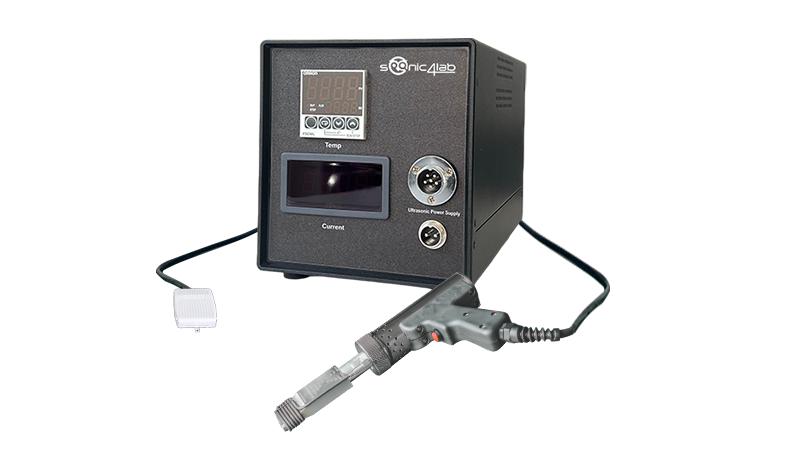
The emergence of ultrasonic soldering iron technology provides the optimal solution for joining aluminum-copper composite heat sinks. This technology uses high-frequency vibration of 20-40kHz as its core, combined with a low-temperature environment of 200-280℃, to induce microscopic plastic flow on the surfaces of aluminum and copper without reaching the metal’s melting point. This breaks down the oxide film on the metal surface, promoting efficient diffusion and fusion of the two metal atoms. The low-temperature environment fundamentally inhibits the growth of brittle intermetallic compounds, completely avoiding the risk of joint embrittlement.
Compared to traditional processes, ultrasonic soldering iron connections achieve a qualitative leap in joint performance, with tensile strength reaching 15-25N, far exceeding traditional brazing standards, and easily handling complex conditions such as vibration and impact. Meanwhile, the joint’s thermal conductivity remains above 150 W/(m·K), enabling efficient heat transfer and perfectly matching the heat dissipation requirements of composite heat sinks. Its compact size and precise operating range make it suitable for medium-sized products such as automotive LED headlight heat sinks and server CPU heat sinks, as well as meeting the manufacturing requirements of small, precision heat sinks.
This technology not only solves the industry pain point of joining dissimilar metals like aluminum and copper, but also balances cost control and performance improvement, providing technical support for structural innovation in the heat sink industry. As industrial manufacturing upgrades towards precision and efficiency, ultrasonic connection technology will play a core role in more dissimilar metal composite components, driving the development of heat dissipation equipment towards lighter, more stable, and more efficient directions.
If you want to purchase equipment, please click here.
