
Application of Solder in FPC Connector Soldering
Application of Solder in FPC Connector Soldering – Sonic4lab
In the field of flexible electronics manufacturing, flexible printed circuit boards are widely used in various precision electronic devices due to their advantages of being thin, flexible, and adaptable to complex installation scenarios. As the core interface for signal transmission, the soldering quality of PCB connectors directly determines the stability and lifespan of the equipment. Ultrasonic soldering technology, with its high efficiency, precision, and environmental friendliness, has become the preferred solution for PCB connector soldering, effectively solving many pain points of traditional soldering methods.
The core principle of ultrasonic soldering for PCB connector soldering is to utilize the energy generated by high-frequency ultrasonic vibration to achieve a reliable bond between the solder and the connector/PCB pads. During the soldering process, ultrasonic vibration is transmitted to the solder area through the solder head. This rapidly melts the solder and, through the vibration effect, breaks down the oxide layer on the PCB pads and connector pins, while also dispersing air bubbles at the soldering interface. This allows the molten solder to fully wet the contact surface, forming a strong metallurgical bond after cooling, thus achieving stable electrical signal transmission.
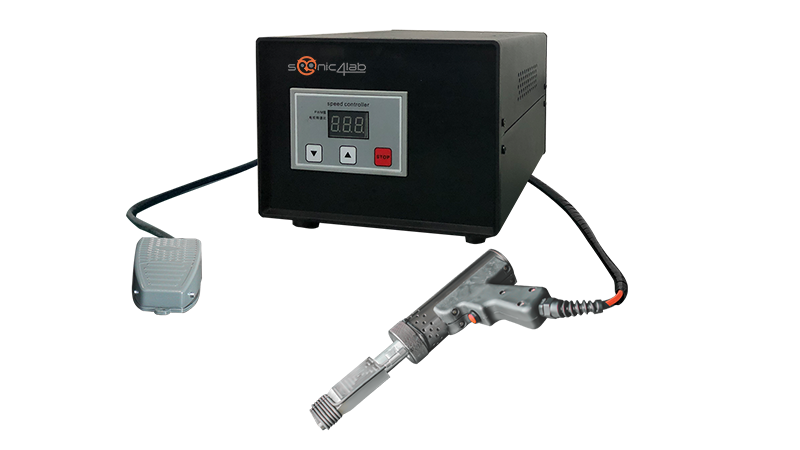
Compared to traditional soldering processes, ultrasonic soldering has significant advantages in PCB connector soldering. First, the welding temperature is low and the heat-affected zone is extremely small (typically less than 0.1mm), far below the temperature limit of the flexible printed circuit board (PCB) substrate. This effectively prevents deformation and carbonization of the PCB substrate, while also preventing damage to the connector’s plastic shell due to high temperatures, ensuring the product’s appearance and structural integrity. Second, the welding process requires no flux, eliminating the risk of corrosion and short circuits caused by flux residue, meeting environmentally friendly production standards, and is particularly suitable for the welding requirements of precision electronic equipment.
Furthermore, ultrasonic soldering offers extremely high welding precision, allowing for precise control of solder quantity and welding position. It is suitable for welding the tiny pins of PCB connectors, achieving precision welding with a minimum line width of 0.3mm and a pitch of 0.2mm. It exhibits low on-resistance and high stability, maintaining good connection performance even after multiple thermal cycling tests. Simultaneously, this process boasts high welding efficiency and short welding time per cycle, making it suitable for automated production lines, significantly improving production efficiency, reducing errors from manual operation, and decreasing the defect rate.
In practical applications, key points must be carefully controlled when using ultrasonic soldering for PCB connectors. Before soldering, the pads and connector pins of the flexible printed circuit board (PCB) must be cleaned to remove surface oil and oxide layers. Parameters such as ultrasonic power, vibration frequency, soldering time, and pressure should be set appropriately to ensure the solder melts fully without damaging the PCB substrate. After soldering, the solder joints must be inspected to confirm the absence of cold solder joints, missing solder joints, or bridging, ensuring soldering reliability.
As electronic devices evolve towards miniaturization, thinner designs, and higher reliability, the soldering requirements for PCB connectors are constantly increasing. Ultrasonic soldering technology, with its core advantages of precision, environmental friendliness, and high efficiency, effectively adapts to the special needs of PCB soldering. It not only improves soldering quality and production efficiency but also reduces production costs and environmental pressure. It plays an increasingly important role in the manufacturing of PCBs in new energy, smart wearables, and automotive electronics, driving the upgrading of flexible electronics manufacturing processes towards higher quality and greater intelligence.
If you want to purchase equipment, please click here.
