
Ceramic Sputtering Targets and Copper or Aluminium Bonding Plates
Technical Characteristics and Applications of Ultrasonic Welding Systems, Ceramic Sputtering Targets and Copper or Aluminium Bonding Plates
In high-end industrial fields such as new energy, semiconductors, and electronics manufacturing, ultrasonic welding systems, ceramic sputtering targets, and copper-aluminum bonding plates, each with its unique technological advantages, form a key material processing and joining system. These three technologies support each other in process and synergistically enhance each other in application, jointly driving the upgrading and development of precision manufacturing technology.
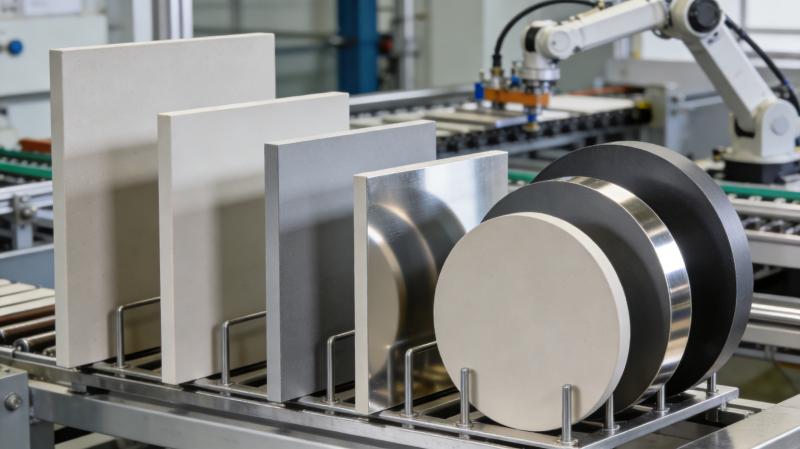
Ultrasonic welding systems, as a highly efficient solid-state joining technology, achieve atomic-level bonding between materials through high-frequency mechanical vibration, enabling precise joining of dissimilar materials without the need for additional solder. Its core parameters include a frequency range of 15kHz-70kHz, an amplitude adjustment range of 10μm-50μm, and precisely controllable welding pressure and time, allowing for adaptation to different working conditions based on material characteristics. In metal welding scenarios, the “cold welding” process avoids the damage to material properties caused by high temperatures, making it particularly suitable for joining fragile components such as lithium battery tabs and precision electronic components. This system removes the oxide layer from the material surface through mechanical vibration, enhancing interfacial wettability. Combined with active solder, it enables reliable bonding between ceramic and metal, providing crucial technical support for the bonding of ceramic sputtering targets to copper-aluminum backing plates.
Ceramic sputtering targets are core materials in physical vapor deposition (PVD) processes. They are made from high-purity ceramic powder through hot pressing or hot isostatic pressing sintering, exhibiting high density, excellent chemical stability, and precise compositional uniformity. Common types include alumina, boron carbide, and silicon dioxide. Alumina targets are widely used in semiconductor packaging and optical coatings due to their high hardness and optical properties, while boron carbide targets are used in nuclear industry protective coatings due to their extremely high wear resistance and neutron absorption capacity. Target purity is typically required to be ≥99.5%, and density not less than 98% of theoretical density to reduce particle splashing and cracking during sputtering. For efficient sputtering, the ceramic target must be firmly bonded to a copper or aluminum backing plate; the quality of this bond directly affects sputtering efficiency and thin film performance.
Copper-aluminum bonding plates achieve integrated molding of copper and aluminum through metallurgical composite technology, combining the excellent electrical and thermal conductivity of copper with the lightweight and low-cost advantages of aluminum. The mainstream semi-molten rolling composite technology can form a 100% metallurgical bond in a high-temperature, high-pressure, oxygen-free environment, with an interface layer thickness controlled below 2μm, a peel strength exceeding 15N/mm, and no interface oxide residue, significantly superior to traditional solid-solid composite and friction welding processes. Its thickness can be adjusted within the range of 0.1mm-2.0mm to adapt to different application scenarios. In the lithium battery field, it can be used for negative electrode post conversion and tab connection, reducing interface resistance to achieve battery pack cooling and improve cycle reliability.

There is a close process synergy among these three components in industrial applications. The connection between ceramic sputtering targets and copper-aluminum backplates often employs ultrasonic welding technology. Through the synergistic effect of active solder and high-frequency vibration, a titanium-based reaction layer is formed on the ceramic surface, improving wettability and increasing joint shear strength, up to 35MPa. In lithium-ion battery manufacturing, ceramic sputtering targets are used to deposit protective electrode films, copper-aluminum bonding plates connect the electrodes to external circuits, and ultrasonic welding systems ensure the precision and reliability of these connections. Together, these three components contribute to improved battery energy density and lifespan. Furthermore, in semiconductor packaging, the low resistance of copper-aluminum bonding plates complements the insulating films prepared by ceramic sputtering targets, while the high precision of ultrasonic welding meets the assembly requirements of micro-components.
In the future, as high-end manufacturing demands increased precision and energy efficiency, these three components will evolve towards greater refinement. Ultrasonic welding systems will enhance intelligent parameter control capabilities, ceramic sputtering targets will pursue submicron-level powder preparation and 3D structure adaptability, and copper-aluminum bonding plates will focus on ultra-thin specifications and customized complex shapes, continuously providing core materials and process support for strategic emerging industries such as new energy and semiconductors.
If you want to purchase equipment, please click here.

