
Ultrasonic Assisted Welding of Sn Based Solder Alloys
In the fields of electronic packaging, new energy devices, and high-end equipment manufacturing, the reliability and precision of welding connections directly determine product performance and lifespan. Sn-based solder alloys, due to their moderate melting point, strong compatibility, and controllable cost, have become one of the mainstream welding materials. However, traditional Sn-based solder welding is prone to problems such as oxide film formation and insufficient interfacial wetting, resulting in low joint strength and poor stability. The integration of ultrasonic-assisted welding technology, through the synergistic effect of acoustic energy and metallurgical reaction, has completely broken through the bottlenecks of traditional processes, propelling Sn-based solder welding technology to a new level of efficiency, greenness, and precision.
The core advantage of ultrasonic-assisted welding stems from its unique physical mechanism. When ultrasound with a frequency exceeding 20kHz acts on molten Sn-based solder, it triggers a significant cavitation effect: numerous microbubbles form in the liquid solder. The rapid growth and collapse of these bubbles releases localized high temperature and pressure, instantly breaking down the oxide film on the base material surface, achieving a clean welding interface without the need for additional flux. Simultaneously, the acoustic flow effect generated by ultrasonic vibration accelerates the flow and agitation of liquid solder, promoting element diffusion between Sn-based solder and the base material, resulting in a more complete interfacial reaction, effectively refining the intermetallic compound grains, and avoiding the component segregation problem commonly found in traditional welding. Experimental data shows that under ultrasonic action, the dissolution rate constant of Sn-based solder on Al base material increases by approximately 6 times, and the diffusion coefficient increases by 7 times, laying the microstructural foundation for forming high-quality joints.
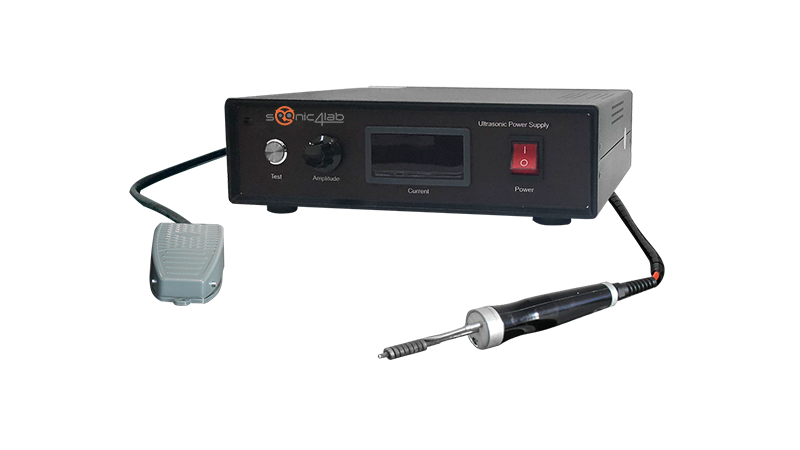
Compared with traditional welding processes, ultrasonic-assisted welding of Sn-based solder alloys exhibits three core technological advantages. First, it offers significant low-temperature and environmentally friendly characteristics. This technology can complete welding in a medium-low temperature environment of around 260℃, avoiding damage to the base material properties caused by high-temperature welding. It is particularly suitable for joining high-temperature sensitive materials such as 2024 aluminum alloy, effectively preventing the redissolution of strengthening phases and the formation of hot cracks. At the same time, the flux-free process design completely eliminates the risk of residual corrosion, aligning with the concept of green manufacturing. Second, it significantly improves the mechanical properties of the joint. The grains refined by the ultrasonic cavitation effect and the uniformly distributed strengthening phase significantly improve the joint strength and toughness. For example, when using Sn-9Zn brazing filler metal for ultrasonic welding of 2024 aluminum alloy, the tensile strength of the joint can reach 158-189 MPa, more than four times that of pure Sn brazing filler metal welding; the shear strength of Cu/Ni foam-reinforced Sn-based solder joints can reach up to 86.9 MPa, and the weld melting point is increased to 800℃, meeting the requirements of high-temperature operating conditions. Thirdly, it has a wide range of applicable materials. In addition to conventional metal materials, this technology can also achieve reliable connections between difficult-to-weld materials such as glass, ceramics, and SiC semiconductors and metals, such as successfully completing the precision welding of 120μm glass optical fiber to bronze holes, and the low-temperature direct bonding of SiC to DBA substrates.
With these advantages, ultrasonic-assisted welding of Sn-based solder alloys has been applied on a large scale in several high-end manufacturing fields. In the field of electronic packaging, this technology addresses the high-power, high-temperature operating requirements of third-generation semiconductor SiC devices by forming a stable amorphous Al₂O₃ reaction layer through the activation reaction at the Al-SiC interface. This solves the problems of complex and unreliable traditional packaging processes, providing crucial support for the miniaturized integration of SiC power modules. In the new energy sector, this technology is used in power battery manufacturing to weld cell tabs to busbars, achieving a metallurgical bond of 12 layers of 0.1mm copper-aluminum foil within 0.2 seconds. This increases welding strength by 40% while controlling connection impedance fluctuations within ±5%, ensuring battery charge/discharge efficiency and cycle life. In the aerospace field, this technology is used for low- and medium-temperature connections of aluminum alloy components, preventing softening of the base material. The joint shear strength reaches 177-184MPa, meeting the dual requirements of lightweight and high reliability for aircraft. Furthermore, this technology also demonstrates irreplaceable advantages in precision manufacturing scenarios such as solar cell contacts and optical device packaging.
In the future, with the development of intelligent manufacturing technology, Sn-based solder alloy ultrasonic-assisted welding technology will be upgraded towards precise parameter control and multi-material synergistic adaptation. By optimizing the combination of parameters such as ultrasonic frequency, amplitude, and action time, welding stability can be further improved; combined with the development of composite brazing filler metals, such as adding nano-reinforcing phases or alloying elements, it is expected to achieve customized optimization of joint performance.
If you want to purchase equipment, please click here.

