
Ultrasonic Soldering in Electronics
Advantages and Research Directions of Ultrasonic Soldering in Electronics
In the technological iteration process of the electronics manufacturing industry, welding technology, as a core link to ensure the stability of component connections and product reliability, has always received much attention for its upgrading and optimization. Although traditional flux welding has been used in the industry for a long time, it has gradually revealed many shortcomings in the face of increasingly stringent environmental requirements, continuously extending product shelf life, and a clear trend towards lead-free products. Against this backdrop, ultrasonic welding technology for electronic components, with its unique technical characteristics, has become an ideal alternative to flux welding, providing a new path for the green and high-quality development of the electronics manufacturing industry.
The most significant advantage of ultrasonic welding technology lies in its environmental friendliness. In traditional flux welding, the volatilization of flux produces a large amount of harmful gases and residues. These substances not only threaten the health of operators but also pollute the atmosphere, soil, and water resources. The subsequent residue cleanup also increases production energy consumption and environmental treatment costs. Ultrasonic welding does not rely on flux. Its core principle is to use the mechanical energy generated by high-frequency ultrasonic vibrations to cause plastic deformation and frictional heat at the welding interface, achieving atomic diffusion bonding. The entire process produces no harmful gas emissions and no difficult-to-clean chemical residues, reducing the negative environmental impact of welding from the source, perfectly aligning with the current global manufacturing green and low-carbon development concept.
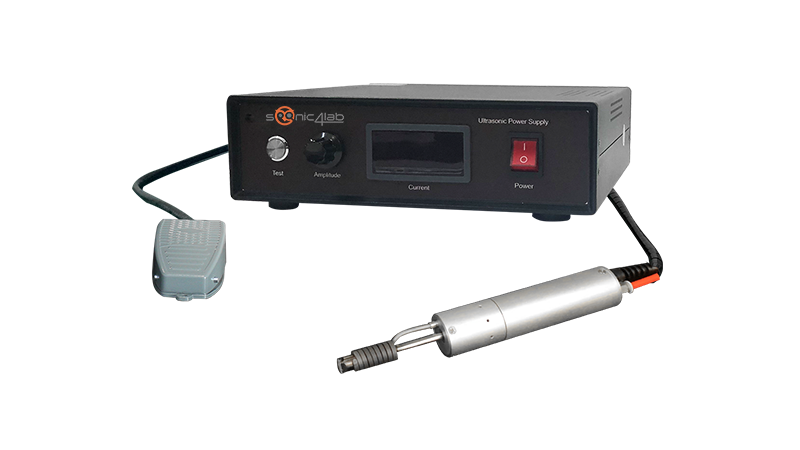
Ultrasonic welding also demonstrates irreplaceable advantages in improving the welding connection quality of components installed after long-term storage. During long-term storage, the pins or welding interfaces of electronic components are susceptible to the effects of oxygen, moisture, and other environmental factors, forming oxide or rust layers. While traditional flux welding can partially remove oxide layers, its effectiveness in cleaning stubborn oxide layers formed over long-term storage is limited, easily leading to problems such as incomplete or false welds, thus affecting product lifespan and operational stability. In contrast, during ultrasonic welding, the mechanical force generated by high-frequency vibrations effectively breaks down the oxide layer at the welding interface, allowing fresh metal surfaces to fully contact. Simultaneously, the frictional heat generates a dense weld joint structure with higher bonding strength. Even for electronic components stored for extended periods, ultrasonic welding ensures stable weld quality, significantly reducing the risk of product failure due to welding defects and providing a solid guarantee for the long-term reliable operation of electronic equipment.
The permission to use lead-free solder is a key advantage of ultrasonic welding in aligning with the industry’s lead-free trend. As global environmental regulations tighten restrictions on lead content, lead-free electronic products have become an inevitable trend. However, compared to traditional lead-containing solders, lead-free solders have higher melting points and poorer wettability, making it difficult to guarantee weld quality with traditional flux. The mechanical vibration and frictional heat generation characteristics of ultrasonic welding effectively improve the wettability of lead-free solders, reducing their welding temperature requirements, and enabling high-quality weld connections even when using lead-free solders. This advantage not only helps companies meet the regulatory requirements for lead-free production but also further enhances the environmental attributes of their products, strengthening their competitiveness in the global market.
To further explore the application potential of ultrasonic welding technology and promote its wider application in the electronics manufacturing industry, related research focuses on continuously deepening core technology aspects. Among these, research on ultrasonic welding solder melt activation methods is crucial. The activation level of the solder melt directly affects the quality of the weld joint. By studying the influence of ultrasonic parameters (such as frequency, power, and duration) on the fluidity of the solder melt and the interfacial reactivity, and optimizing the activation process parameters, welding efficiency and joint strength can be further improved, providing customized solutions for the welding needs of different types of electronic components.
Research on lead-free solder in ultrasonic welding focuses on solder formulation optimization and performance improvement. Researchers have developed a lead-free solder system with low melting point, high wettability, and high mechanical properties by adjusting the composition ratio of lead-free solder, adding trace alloying elements, and combining it with the technical characteristics of ultrasonic welding. Simultaneously, research on the compatibility of lead-free solder with ultrasonic welding processes is being conducted to ensure the reliability of welded products under complex operating conditions, considering the needs of different application scenarios (such as high-temperature environments and precision electronic equipment).
Research on the metallization process of glass-ceramic capacitors is a key breakthrough direction for ultrasonic welding technology in specific component applications. Glass-ceramic capacitors have excellent properties such as high frequency, low loss, and high temperature resistance, and are widely used in precision electronic equipment; however, the connection between the metallization layer and the electrodes is challenging. By studying the impact of ultrasonic welding on the metallization layer of glass-ceramic capacitors, and optimizing the material selection, preparation process, and welding parameters of the metallization layer, the connection strength between the metallization layer and the electrode can be effectively improved, contact resistance reduced, and the performance advantages of glass-ceramic capacitors fully utilized, thus promoting the performance upgrade of precision electronic equipment.
In summary, ultrasonic welding technology for electronic components, with its core advantages of being environmentally friendly, high-quality, and compatible with lead-free solder, has completely changed many of the drawbacks of traditional flux welding. In-depth research on solder melt activation methods, lead-free solder, and the metallization process of glass-ceramic capacitors has not only further improved the technical system of ultrasonic welding but also broadened its application boundaries. In the future, with the continuous advancement of research and the continuous maturation of technology, ultrasonic welding technology will undoubtedly see wider applications in the electronics manufacturing industry, injecting stronger momentum into the industry’s green and high-quality development.
If you want to purchase equipment, please click here.

