
Ultrasonic Soldering Iron for Special Component Connection
Ultrasonic Soldering Iron for Special Component Connection – Sonic4Lab
In the field of electronic manufacturing and precision assembly, reliable connection of special material components has always been a technical difficulty. Due to significant differences in material properties, traditional welding methods often face issues such as weak bonding and component damage for bimetallic, ceramic metal, active ceramic, and passive ceramic components. Ultrasonic soldering iron, with its composite working mode of “ultrasonic vibration+local heating”, effectively breaks through these limitations and becomes an ideal tool for connecting such components. Its application has also promoted the process upgrade in the field of precision manufacturing.

The core advantage of ultrasonic soldering iron lies in its unique working principle. It integrates a high-frequency ultrasonic vibration module on the basis of conventional electric soldering iron heating function. During operation, the soldering iron tip synchronously transfers heat to the welding interface with mechanical vibration of 20-40kHz. This vibration can generate microscopic cavitation effects, breaking down the oxide film and pollutants on the metal surface, while promoting molecular diffusion between the solder and the material being welded, forming stable bonds at lower temperatures. Compared with traditional welding, its heating is more concentrated, and the heat affected zone is only one-third of that of a conventional soldering iron, greatly reducing the risk of damage to the thermistor. This characteristic is crucial for connecting special material components.
Bimetallic components are composed of two metals with different coefficients of thermal expansion, and are widely used in temperature control and measurement equipment. Their connection needs to balance mechanical strength and thermal stability. The high temperature of traditional welding can easily cause thermal stress between two metals, leading to deformation or cracking of the bonding layer. Ultrasonic soldering iron uses precise temperature control (usually set at 200-280 ℃), combined with ultrasonic vibration to remove the oxide layer on the metal surface, so that the solder can evenly fill the connection gap between the two metals. When connecting copper nickel bimetallic sheets, the uniformity of the bonding layer thickness formed is increased by 40%, and after cold and hot cycling tests from -40 ℃ to 120 ℃, there is no significant deformation at the connection site, meeting the requirements for use in harsh environments.
The difficulty in connecting ceramic metal components (such as composites of ceramic substrates and metal pins) lies in the high hardness and low thermal conductivity of ceramics, which makes it difficult for traditional soldering irons to achieve effective infiltration of solder. The vibration energy of ultrasonic soldering iron can penetrate the ceramic surface, generating micro frictional heat at the interface between metal and ceramic, promoting chemical reactions between the active components in the solder and the ceramic surface, forming chemical bonds. In the welding of ceramic metal bases, using silver containing solder with ultrasonic soldering iron can achieve a connection strength of over 15MPa, far higher than the traditional welding of 8MPa, and the insulation performance is not affected, making it suitable for packaging scenarios of power modules.
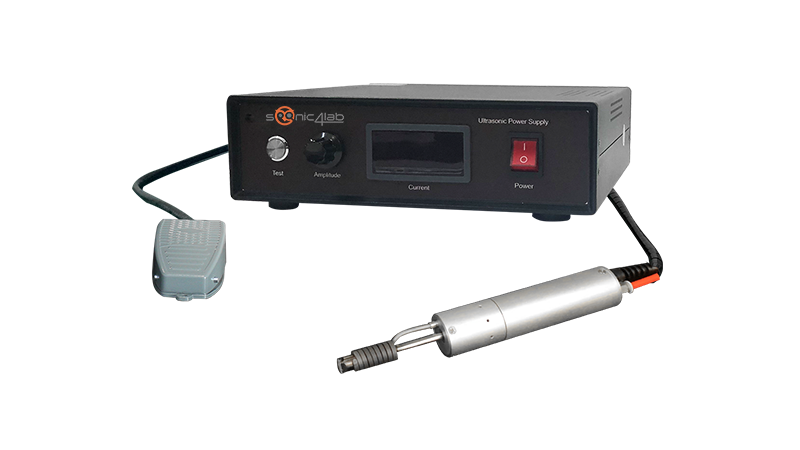
Active ceramic components such as ceramic capacitors, piezoelectric devices, etc. contain sensitive circuits or polarized structures inside, and welding temperatures exceeding 300 ℃ can cause performance degradation. The low-temperature soldering characteristics of ultrasonic soldering iron are outstanding in the connection of such components. The soldering iron tip uses a special thermal conductive alloy, which can control the temperature error within ± 5 ℃. When welding active ceramic sensors, by adjusting the ultrasonic power to 15-20W, welding can be completed at 180-220 ℃. Compared with traditional soldering irons, the stability of the electrical performance parameters of the components is improved by 50%, and the qualification rate is increased from 78% to over 95%. At the same time, the cleaning effect generated by vibration can also reduce welding slag residue and lower the risk of subsequent circuit short circuits.
Passive ceramic components such as ceramic resistors, ceramic insulators, etc., although lacking thermal sensitivity, are mostly miniaturized structures, and traditional welding is prone to virtual welding or positioning deviation. The micro soldering iron tip (minimum diameter 0.3mm) equipped with the ultrasonic soldering iron can accurately align with the connection point, and the vibration effect enables the solder to quickly form, reducing solder overflow. In the assembly of high-density ceramic circuit boards, it can achieve efficient batch welding of 0402 specification passive ceramic components, with a welding efficiency of over 3000 points per hour and a virtual soldering rate of less than 0.1%. In addition, for ceramic components with glaze layers on the surface, ultrasonic vibration can complete welding without damaging the glaze layer, preserving the insulation and appearance performance of the components.
When using ultrasonic soldering iron to connect such special components, process parameters need to be matched according to material characteristics: bimetallic components focus on controlling temperature gradients, ceramic metal components need to optimize vibration frequencies, active ceramic components should prioritize low temperatures, and passive ceramic components focus on soldering iron tip accuracy. At the same time, it is necessary to use lead-free environmentally friendly solder to reduce the corrosion impact on the material. With the development of electronic devices towards miniaturization and high reliability, the application scenarios of ultrasonic soldering irons in special component connections will be further expanded, providing more efficient and reliable process solutions for precision manufacturing.
If you want to purchase equipment, please click here.
