
Ultrasonic Soldering Iron in Sensor Connection
Application and technical characteristics of ultrasonic soldering iron in sensor connection – Sonic4lab
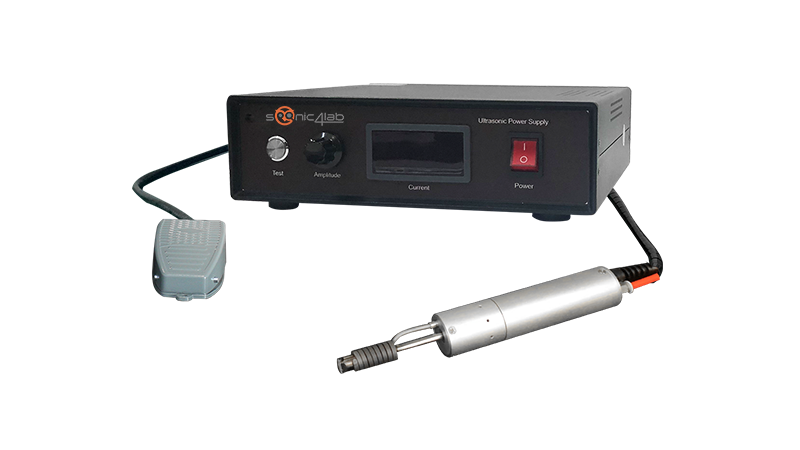
In the field of precision electronic manufacturing and sensor technology, the reliability of the connection process directly determines product performance and service life. Ultrasonic soldering iron, with its composite working mode of “ultrasonic vibration+precise temperature control”, breaks through the limitations of traditional connection technology, especially in the magnetic flux free connection between electrical signal leads and sensor components, demonstrating unique advantages and providing core technical support for the preparation of high-sensitivity sensors. The combined application of twisted leads and special material components such as graphite and active ceramics has further promoted the performance upgrade of conductivity and strain sensors.

The core advantage of ultrasonic soldering iron lies in its non-contact energy transfer characteristics. Unlike traditional electric soldering irons that rely on thermal conduction for heating, it uses high-frequency ultrasonic vibration (usually 20-40kHz) to cause violent movement of molecules at the welding site, combined with precise and controllable low-temperature heating (usually at 150-300 ℃), to achieve atomic level bonding between metal leads and sensitive components. This method avoids magnetic flux interference caused by electromagnetic induction, which often leads to sensor signal drift and a decrease in signal-to-noise ratio. Therefore, in high-precision measurement scenarios, magnetic flux free connections have become a technical necessity.
The value of magnetic flux free characteristics is particularly prominent in the connection between electrical signal leads and sensor components. Sensor components are mostly magnetic or electrically sensitive structures. In traditional welding processes, the electromagnetic radiation and high-temperature thermal shock of electric soldering irons can easily damage the internal lattice structure of the components, leading to a decrease in parameter stability. Ultrasonic soldering iron focuses vibration energy on the connection interface, without affecting the performance of the component itself, to break the oxide layer on the surface of the twisted lead, exposing the fresh metal surface and forming a strong bond with the component. This type of connection not only has a stable resistance value (usually controlled below 10m Ω), but also significantly improves its ability to resist vibration and temperature changes. Its service life in industrial environments is extended by 3-5 times compared to traditional welding methods.
The combination application of twisted leads and graphite components is one of the typical scenarios of ultrasonic soldering iron technology. Graphite has excellent conductivity and thermal stability, but its surface is smooth and chemically inert, making it difficult to form effective bonds through traditional welding. Through the vibration of an ultrasonic soldering iron, twisted leads (usually silver plated copper wire or pure copper wire) generate microscopic friction with the surface of graphite, disrupting the arrangement of carbon atoms on the graphite surface and forming a diffusion bonding layer between metal atoms and carbon atoms. The conductivity sensor made by this combination can be used to monitor the conductivity changes of liquid media, and is widely used in water quality monitoring and chemical reaction process control. Its measurement accuracy is 15% -20% higher than traditional electrode sensors, and the response time is shortened to milliseconds.
The connection with active ceramic components can better reflect the breakthrough of this technology. Activated ceramics (such as barium titanate based ceramics) have piezoelectric properties and strain sensitivity, but they are brittle and have a low coefficient of thermal expansion. Traditional mechanical connections are prone to stress concentration, leading to component fracture. Welding at high temperatures can damage their piezoelectric properties. Ultrasonic soldering iron precisely controls the vibration amplitude (5-20 μ m) and heating temperature (below the Curie temperature of ceramics) to form a composite connection structure of “mechanical bite+micro metallurgical bonding” between the twisted lead and the ceramic surface. This connection method not only avoids mechanical stress damage, but also ensures the continuity of signal transmission. The strain sensor made from this can be used for deformation monitoring of aerospace structural components, and can maintain a measurement accuracy of 0.1% even in extreme environments ranging from -50 ℃ to 200 ℃.
The key technical points in this application scenario are parameter matching and surface pretreatment. For graphite components, the ultrasonic power should be controlled between 80-120W, the vibration frequency should be 35kHz, and the graphite surface should be sandblasted to increase roughness; Active ceramic components need to reduce power to 50-80W, use 20kHz low-frequency vibration, and remove hydroxyl impurities on the ceramic surface through plasma cleaning. In addition, the number of strands (usually 7-19 strands) and twist length of the twisted lead wire also need to be adjusted according to the size of the component to ensure uniform transmission of vibration energy.
With the development of sensor technology towards miniaturization and high reliability, the application boundaries of ultrasonic soldering irons are constantly expanding. In the fields of flexible electronic sensors, biomedical sensors, etc., their connection characteristics of no magnetic flux, low temperature, and low damage have become the core process guarantee. In the future, by combining with machine vision and automation control systems, this technology will achieve precise closed-loop control of the connection process, further improving the consistency and stability of sensor products, and providing strong support for the upgrading of the precision manufacturing industry.
If you want to purchase equipment, please click here.
