
Ultrasonic Soldering Iron Welding Heat Exchanger
Ultrasonic Soldering Iron Welding Heat Exchanger – Sonic4Lab
As the core component of energy transfer and recovery systems, the welding quality of heat exchangers directly determines the heat transfer efficiency, sealing performance, and service life of the equipment. Traditional welding techniques often face problems such as uneven distribution of solder and incomplete removal of oxide layers when dealing with thin-walled tubes and irregular interfaces in heat exchangers. Ultrasonic soldering iron combines high-frequency vibration with precise heating, providing an efficient and reliable solution for heat exchanger welding, and demonstrating significant advantages in fields such as HVAC, automotive cooling, and industrial waste heat recovery.

The core advantage of ultrasonic soldering iron comes from the mechanism of “thermal mechanical coupling”. Unlike ordinary soldering irons that rely solely on the heating element to conduct heat, this device converts high-frequency electrical signals into mechanical vibrations of 20-40kHz through a transducer while heating. This micro vibration can penetrate the surface of solder, quickly destroy the metal oxide layer, and fully contact the fresh metal surface, fundamentally solving the problem of virtual soldering caused by the oxidation of commonly used metals such as copper and aluminum in heat exchangers. At the same time, the vibration effect accelerates the flow of solder, allowing the molten solder to be evenly filled in the narrow gaps between pipes, especially suitable for welding operations in densely packed heat exchanger tubes.
The precise temperature control characteristics of ultrasonic soldering iron are crucial in heat exchanger welding operations. The device controls temperature fluctuations within a range of ± 5 ℃ through a closed-loop temperature control system, and can flexibly adjust parameters according to different pipe combinations. When welding copper copper interfaces, the temperature is usually set between 380-420 ℃, and high-frequency vibration is used to promote solder infiltration; When processing aluminum copper dissimilar metal welding, the temperature is reduced to 320-350 ℃, and the obstacles caused by the formation of intermetallic compounds are overcome through low-frequency strong vibration. This precise control can not only avoid deformation of the pipe caused by high temperature, but also ensure stable metallurgical bonding between the solder and the substrate, significantly improving the pressure resistance of the interface. After testing, the pressure resistance strength of the welded joint has been increased by more than 30% compared to traditional processes.
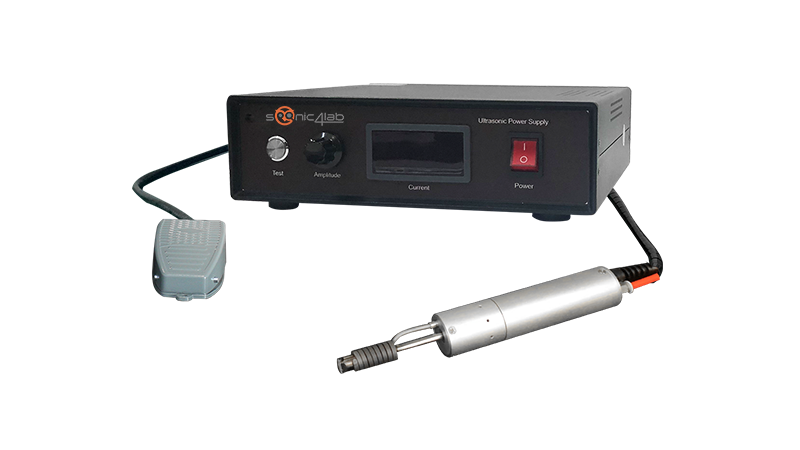
The standardization of operational processes is the key to leveraging technological advantages. Before welding, the interface of the heat exchanger needs to be pre treated by removing oil stains with anhydrous ethanol, and then removing the surface oxide layer through ultrasonic cleaning to ensure the cleanliness of the welding surface. When welding, the operation logic of “point line surface” is adopted. First, the tip of the soldering iron is positioned at the center of the interface, and ultrasonic vibration is turned on for 3-5 seconds to establish a heat conduction channel. After the solder begins to melt, slowly move the soldering iron tip to form a continuous and uniform weld bead. After welding is completed, keep the interface still and cool for more than 20 seconds to avoid external interference that may cause solder crystallization defects. The entire process does not require the use of soldering flux, which reduces the risk of welding residue blocking the internal channels of the heat exchanger and meets environmental requirements.
This technology has more advantages in the manufacturing of heat exchangers under special working conditions. In the production of fuel cell heat exchangers for vehicles, their low-temperature rapid welding capability can prevent damage to the proton exchange membrane; In the welding of corrosion-resistant heat exchangers in the chemical industry, the residue free characteristic reduces the risk of medium pollution; In the manufacturing of small household heat exchangers, the efficient welding characteristics increase production efficiency by more than 40%. With the increasing demand for miniaturization and high efficiency of heat exchangers in industrial manufacturing, ultrasonic soldering iron welding technology is developing towards integration. In the future, by combining automated robotic arms and visual positioning systems, batch precise welding of complex structure heat exchangers can be achieved.
Ultrasonic soldering iron welding technology solves multiple technical bottlenecks in heat exchanger welding through the synergistic effect of vibration and heat. Its environmental friendliness, efficiency, and reliability make it an important technical direction in the field of heat exchanger manufacturing. With the advancement of materials science and control technology, this technology will play a role in a wider range of industrial scenarios, providing strong support for the performance upgrade of heat exchange equipment.
If you want to purchase equipment, please click here.
