
Ultrasonic Welding Machine Reshaping Process
1.Working Principle
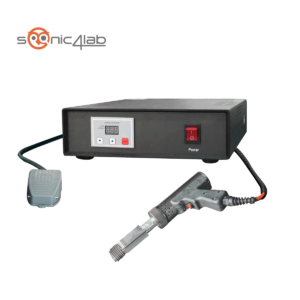
The handheld ultrasonic welding machine achieves welding through the conversion of high-frequency electrical energy to mechanical vibration. The ultrasonic generator generates an electrical signal of 20kHz-40kHz, which is converted into a same-frequency vibration by the transducer, and then amplified by the amplitude transformer and transmitted through the welding head. When in contact with materials, high-frequency vibration triggers molecular friction and heat generation, causing local melting of the materials. Under pressure, they fuse and cool to form a firm joint. This process does not require filler materials. The welding only takes 0.5 to 2 seconds, significantly improving efficiency.
2.Significant Advantages
(1) Portable, flexible and easy to operate
The handheld ultrasonic welding machine weighs only 1 to 3 kilograms, supports handheld operation, and can work deep inside complex workpieces or in narrow Spaces. Its minimalist operation interface significantly shortens the training cycle and greatly reduces labor costs.
(2) High efficiency and energy conservation, enhancing production capacity
The high-frequency vibration characteristics increase the welding efficiency by 3 to 5 times compared with traditional methods. For instance, the welding of small plastic products has been shortened from 5 to 8 seconds to 1 to 2 seconds. Meanwhile, its energy consumption is only 30% to 50% of that of traditional equipment, taking into account both green production and cost control.
(3) Excellent welding quality and strong stability
High-strength sealed joints are formed through molecular-level fusion, with smooth and defect-free welds. The equipment can precisely control energy, time and pressure parameters to ensure stable batch quality, and the welding strength can reach 80%-90% of the raw materials.
(4) A wide range of applicable materials
In addition to common thermoplastics such as PP and PE, it can also achieve composite welding of plastics with metals, fabrics, etc., and is widely used in scenarios such as electronic flexible circuit board packaging and seamless splicing of automotive interiors.
3. Welding Tools for Multiple Industries
(1) Electronics industry: Reliable connection of precision components
In the manufacturing of electronic products, handheld ultrasonic soldering machines are widely used in the packaging of small components, the soldering of circuit boards and the processing of data cable ends. For instance, the welding of mobile phone charger casings and smartwatch straps not only meets the requirements of high precision and aesthetics but also enhances the water and dust resistance, improving the durability of the products.
(2) Automotive Industry: Efficient assembly of interiors and components
Automotive interior welding emphasizes both aesthetics and environmental protection. This device can be used for welding components such as instrument panels, door panels, and headrests, achieving seamless connections without any glue residue. In the manufacturing of components, ultrasonic welding of sensor housings and plastic pipe joints ensures stable operation under complex working conditions with high strength and sealing performance.
(3) Medical industry: Precise welding of sterile products
The production of medical supplies has strict requirements for hygiene and safety. Ultrasonic welding does not require glue. The instantaneous welding process effectively avoids bacterial contamination and is suitable for sterile instruments such as syringes and infusion bags. Its precise control ensures the product size and sealing performance, building a solid defense line for medical safety.
(4) Packaging Industry: Efficient and aesthetically pleasing packaging solutions
In the packaging field, ultrasonic welding can seal plastic packaging bags and boxes faster and stronger than traditional heat sealing, and the sealing is neat and beautiful. It is especially suitable for products with high sealing requirements such as food and medicine, which can effectively extend the shelf life, improve packaging quality and production efficiency.
With the continuous progress and innovation of technology, it will play an important role in more fields, promoting the welding process to develop in a more efficient, precise and intelligent direction, and bringing new changes and opportunities to the production and manufacturing of various industries.