
Ultrasonic Welding Sensor and Optical Materials
Ultrasonic Welding Sensor and Optical Materials – Sonic4lab
In the field of precision electronic and optical equipment manufacturing, the connection quality between sensors and optical windows directly determines the detection accuracy and service life of the equipment. The connection of hard and brittle materials such as quartz and sapphire, as well as various metal frames, has always been a technical difficulty. Ultrasonic soldering iron, with its unique energy transfer method, provides an efficient and reliable solution for the connection of such heterogeneous materials, effectively breaking through the limitations of traditional welding processes.

The core advantage of ultrasonic soldering iron lies in the synergistic effect of ultrasonic vibration and local heating. Its working principle is to generate micro friction in the welding area through high-frequency ultrasonic vibration (usually 20kHz-40kHz), while the soldering iron tip provides precise and controllable heat. This composite effect of “vibration+heating” can quickly destroy the oxide layer and adsorption layer on the surface of the material, forming a tight metallurgical bond between the metal solder and the surface of the welded material. The energy is concentrated at the connection interface, avoiding thermal damage to the sensor sensitive components and optical windows. Compared with traditional soldering irons, its heating efficiency is increased by more than 40%, and the welding time can be shortened to a few seconds, greatly reducing the impact of thermal stress on precision components.
The ultrasonic soldering iron exhibits significant adaptability for the connection between quartz and metal frames. Quartz has low thermal expansion coefficient and high hardness characteristics, and traditional welding is prone to sealing failure due to thermal deformation. When using an ultrasonic soldering iron, low melting point silver based solder can be selected, and the solder can be evenly spread on the quartz surface by low-temperature heating at 50-80 ℃ combined with ultrasonic vibration. During the welding process, ultrasonic waves can promote atomic diffusion between the solder and the surface of quartz, forming a transition layer with a thickness of only 2-5 μ m. This not only ensures the connection strength (shear strength can reach over 15MPa), but also avoids cracks in quartz caused by sudden temperature changes. This process is widely used in the packaging of quartz sensing heads for temperature sensors, effectively improving the stability of the sensor in extreme temperature environments.
The connection between sapphire and metal relies more on the precise energy control of ultrasonic soldering iron. Sapphire has a Mohs hardness of up to 9, a smooth surface, and strong chemical stability, making it difficult for solder to infiltrate. By optimizing the ultrasonic power (usually set at 80-120W) and soldering iron tip temperature (120-150 ℃), a micro rough structure can be formed on the surface of sapphire, enhancing the adhesion ability of solder. In optical window packaging, this connection method can achieve a dual guarantee of sealing performance and transmittance. The sealing leakage rate can be controlled below 1 × 10 ⁻⁸ Pa · m ³/s, and the transmittance loss does not exceed 1%, fully meeting the requirements for the use of infrared sensors and laser ranging equipment.
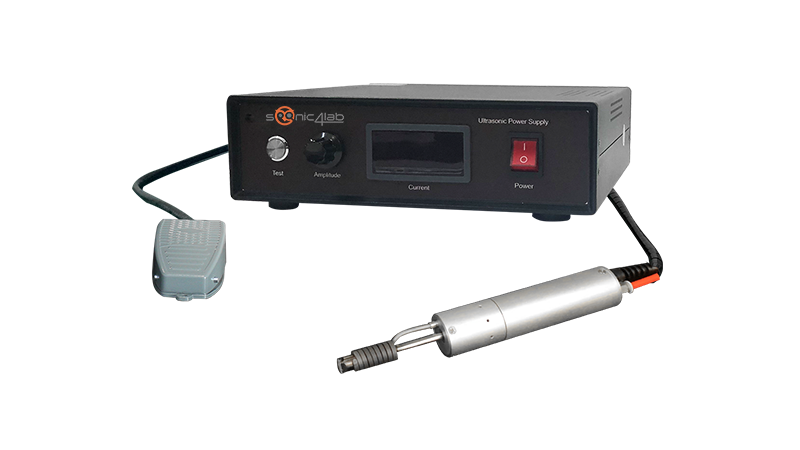
In the scenario of composite connection of multiple materials, the flexibility of ultrasonic soldering iron is particularly prominent. When the sensor component contains quartz sensing elements, sapphire windows, and aluminum alloy frames simultaneously, the overall packaging can be achieved through segmented welding. First, low-power ultrasound is used to pre connect quartz and sapphire, and then the power is increased to achieve a tight bond with the metal frame. The entire process does not require equipment replacement, and continuous welding of heterogeneous materials can be completed through parameter adjustment. This integrated process reduces the assembly process, reduces the volume of the sensor by 15% -20%, and reduces the risk of connection failure caused by multiple processes.
During the operation, attention should be paid to the matching of welding parameters and material properties. For brittle materials such as quartz, the ultrasonic power should not exceed 100W, and the heating time should be controlled within 3-5 seconds; When welding the metal frame, the power can be appropriately increased to 150W to ensure that the solder is fully melted. In addition, the shape of the soldering iron tip needs to be customized according to the connection location. Flat soldering iron tips are suitable for large-area metal connections, while pointed soldering iron tips can accurately apply to the narrow gap between sensor pins and optical windows. Alcohol cleaning and plasma activation treatment of the material surface before welding can further improve the quality of the connection.
With the development of precision manufacturing industry, the application of ultrasonic soldering iron in the connection between sensors and optical windows will become more widespread. Its low temperature, high efficiency, and low damage characteristics perfectly meet the stringent requirements of precision components for connection processes, providing strong support for the development of equipment miniaturization and high reliability. In the future, combining intelligent control systems to achieve adaptive adjustment of welding parameters will become an important development direction for this technology.
If you want to purchase equipment, please click here.
