
Welding of Dissimilar Materials
Ultrasonic soldering machine: a reliable solution to solve the problem of dissimilar material connection
The demand for connecting dissimilar materials such as metals, ceramics, and glass is increasing in industrial production and technological research and development. From ceramic substrates and metal pins in electronic devices to glass observation windows and metal frames in the aerospace industry, two or more materials with vastly different characteristics need to be tightly combined. However, the physical properties (such as melting point and thermal expansion coefficient) and chemical properties of these materials vary greatly, and traditional connection methods often struggle to balance “firmness” and “safety”. The emergence of ultrasonic tin welding machines provides an efficient and reliable solution to this problem.
The dilemma of traditional heterogeneous connections
The connection between metal, ceramics, and glass has long been limited by technological bottlenecks. If high-temperature welding is used, the high-temperature resistance of ceramics and glass is much lower than that of metals, and cracking and deformation are prone to occur at high temperatures; If adhesive is used for bonding, it not only has low connection strength and is easily affected by environmental humidity and temperature, but also may evaporate harmful substances due to the adhesive, which cannot meet the cleanliness requirements in fields such as electronics and medical care; Mechanical connections (such as bolt fixation) can damage material integrity and make it difficult to achieve precise connections of small components. These solutions either sacrifice connection reliability or damage the heterogeneous materials themselves, and cannot achieve the desired connection effect.
Ultrasonic Tin Welding Machine: Achieving Low Temperature Reliable Connection through “Vibration”
The reason why ultrasonic soldering machines can break through the limitations of dissimilar material connections lies in their unique “high-frequency vibration+low-temperature soldering” working principle, which can form a strong bond between tin and dissimilar materials without relying on high temperatures.
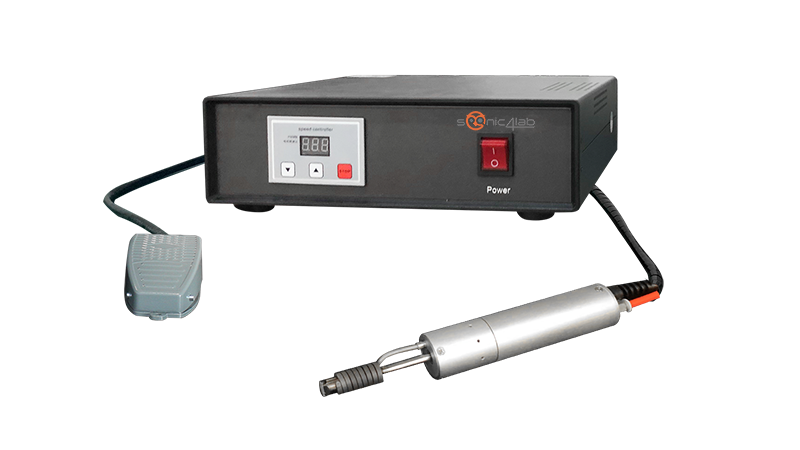
The working process can be divided into three key steps: firstly, the transducer of the equipment converts electrical energy into high-frequency mechanical vibration of 20-40kHz, which is transmitted to the welding head through the amplitude rod; Next, the welding head will vibrate the contact surface between the metal to be connected and the ceramic (or glass), and synchronously transport the tin material. High frequency vibration will cause slight friction on the contact surface, instantly removing the oxide layer and impurities on the material surface. At the same time, it will slightly increase the local temperature (far below the softening temperature of ceramic and glass), causing the tin material to melt quickly and spread evenly; Finally, the tin material fully wets the surfaces of both materials under vibration, and after cooling, forms a connecting layer that combines mechanical strength and conductivity/sealing, achieving “atomic level bonding”.
Throughout the process, the overall temperature of the material remained low, avoiding the problem of ceramic and glass cracking due to thermal stress; At the same time, high-frequency vibration has replaced traditional high-temperature heating in welding, greatly reducing the damage to material properties, especially suitable for dissimilar materials with high brittleness and poor high temperature resistance.
Precise adaptation for metal ceramic and metal glass
In different scenarios of dissimilar material connections, ultrasonic tin welding machines exhibit strong adaptability, providing customized solutions for the connection between metals and ceramics, and metals and glass.
For the connection between metal and ceramics, the high hardness and low thermal conductivity of ceramics used to deter traditional welding. However, ultrasonic tin welding machines remove micro pores and oxide layers on the ceramic surface through vibration, allowing tin to penetrate into small depressions on the ceramic surface and form an “anchoring effect”. For example, in the manufacturing of automobile exhaust sensors, alumina ceramic substrates need to be connected to copper wires. Ultrasonic tin welding machines can complete welding at low temperatures of 60-120 ℃, ensuring that the ceramic substrate does not break and the conductivity of the connection part is stable, meeting the long-term working needs of the sensor in high-temperature exhaust environments.
In the connection between metal and glass, the brittleness and transparency of glass pose higher requirements for the connection technology. The low-temperature characteristics of ultrasonic tin welding machines can prevent glass from cracking due to thermal expansion and contraction, while the uniform spreading of tin material can ensure the sealing of the connection parts. For example, in laboratory optical instruments, quartz glass tubes need to be connected to stainless steel interfaces. Traditional adhesives cannot withstand the vacuum environment inside the instrument, while the connection layer formed by ultrasonic soldering not only has excellent sealing performance, but also does not block the transparent area of the glass, perfectly adapting to the usage needs of optical equipment.
The core advantages behind reliable connections
The reason why ultrasonic tin welding machine can become the preferred solution for dissimilar material connection is due to its irreplaceable core advantages: firstly, high connection reliability, vibration effect allows tin material to form a tight metallurgical bond with dissimilar materials, and the tensile strength and aging resistance of the connection part far exceed adhesive bonding, and can adapt to harsh environments such as high and low temperatures and humidity; Secondly, it causes minimal damage to the material. Low temperature welding avoids thermal damage to ceramics and glass, and the vibration energy is concentrated on the contact surface, without damaging the internal structure of the material; Thirdly, it has a wide range of applications, whether it is planar connection, point connection, or connection of small-sized components (such as metal pins with a diameter less than 1mm and ceramic chips), it can be accurately completed to meet the diverse needs of different industries.
With the increasing demand for precision and reliability of dissimilar material connections in fields such as electronics, new energy, and healthcare, ultrasonic tin welding machines are gradually becoming a key equipment for breaking through material connection boundaries. It not only solves the dilemma of traditional technology, but also promotes the innovative application of heterogeneous materials in more high-end fields, providing important support for the miniaturization and high performance of technological products.
If you want to purchase equipment, please click here
