
Soldering machine efficient and friendly welding new era
In modern manufacturing, the development of welding technology plays a vital role in improving product quality, improving production efficiency and meeting environmental protection requirements. As an innovative welding equipment, ultrasonic soldering machine is gradually emerging and bringing new solutions to many industries.
The working principle of ultrasonic soldering machine is based on the cavitation effect of ultrasonic waves in molten tin liquid. When ultrasonic waves are applied to tin liquid, high-frequency vibrations of up to 20,000 times per second are generated. This strong vibration triggers the cavitation effect, that is, the tiny bubble nuclei in the liquid vibrate under the action of ultrasonic waves. When the sound pressure reaches a certain value, the bubbles expand rapidly and suddenly close, generating powerful shock waves and microjets. These physical phenomena can effectively destroy and remove the oxide layer on the metal surface, allowing the tin liquid to smoothly wet the metal surface, thereby forming a uniform and firm tin layer.
Compared with traditional welding methods, ultrasonic soldering machines have many significant advantages. Among them, the most prominent is its environmental protection characteristics. Since the cavitation effect of ultrasound can directly peel off the oxide layer on the surface of the weldment without the use of flux, this eliminates the problems caused by chemical pollution and flux residue, and fully complies with environmental protection standards such as RoHS. This feature makes the ultrasonic soldering machine have irreplaceable advantages in fields with extremely strict environmental protection requirements, such as semiconductors, medical equipment and other industries. At the same time, the bubble-free and corrosion-free welding effect also makes it perform well in high vacuum sealing scenarios, greatly improving the reliability of the product.
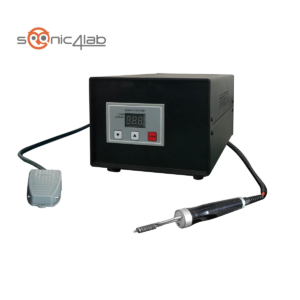
The ultrasonic soldering machine also has wide compatibility and high stability. It can support the welding of a variety of traditional difficult-to-weld materials such as copper, aluminum, nickel, glass, and ceramics, and successfully breaks through the difficulties of welding heterogeneous materials such as aluminum-copper and copper-glass. Moreover, the equipment can still operate stably in a high temperature environment of up to 300°C, and the transducer temperature can be controlled at ≤75°C. Its exquisite small size design can be easily adapted to both laboratory research and small space operations.
In the field of electronic manufacturing, ultrasonic soldering machines can be used for tinning PCB pins and relay contacts, effectively eliminating the phenomenon of false soldering and leaking soldering, and increasing the yield rate by 30%; in the production of automotive wiring harnesses, they can perform antioxidant treatment on aviation wires and sensor terminals to ensure conductive stability and long-term durability; in the new energy and semiconductor industries, they can be used for welding solar cell glass and ceramic heaters, providing strong support for new material development and product innovation.
With the continuous advancement of science and technology, ultrasonic soldering machines will surely play an important role in more fields and inject new vitality into the high-quality development of the manufacturing industry.