
Ultrasonic Earband Welders: Precision “Suture”
Behind the global popularity of true wireless earbuds, an unseen force is quietly reshaping the manufacturing process: ultrasonic earband welders. Eschewing traditional glue bonding and high-temperature welding, they use high-frequency sound waves vibrating tens of thousands of times per second as a “needle and thread,” seamlessly joining delicate earbud components within milliseconds, injecting a new level of precision into consumer electronics manufacturing.
The core of this welding technology lies in converting high-frequency electrical energy into mechanical vibrations. As the welding head vibrates vertically at a frequency of 15kHz to 40kHz, the energy is precisely focused on the tiny area to be welded. Intense molecular friction at the plastic or metal interface instantly generates localized high temperatures, causing the surface layers of the materials to melt and intertwine within 0.1 to 1 second. Cooling results in a dense, molecular-level fusion. Even more remarkable, the entire process requires no solder, adhesive, or flux, eliminating chemical contamination and ensuring the purity of the micro-acoustic cavity.
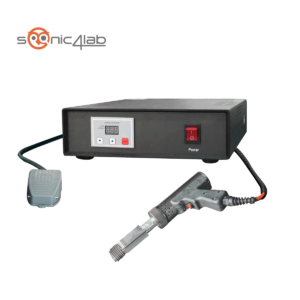
Its technological advantages are particularly prominent in headphone production:
Precision and Markless: The welding head pressure can be precisely controlled within the range of several Newtons, preventing structural damage to acoustic components such as micro-speaker diaphragms and microphones. The welds remain strong and virtually invisible.
Compatible with all materials: Whether it’s ABS engineering plastic, nylon frames, or metal charging contacts, the acoustic wave energy penetrates the surface layer to achieve molecular-level bonding, easily meeting the challenges of splicing over ten different materials in headphones.
Eco-Friendly: The entire process is free of volatile matter emissions, significantly reducing VOC pollution while saving over 97% of glue usage, supporting green manufacturing.
On modern headphone production lines, ultrasonic welders play multiple roles: They vibrate and fuse two thin headphone shells together to form an airtight acoustic cavity; they instantly weld hair-thin charging contacts to flexible printed circuit boards (FPCs); and in headphones, they securely connect metal hinges to nylon headbands, ensuring they withstand tens of thousands of bends. Each precise vibration builds the reliable core of the exquisite headphones at consumers’ fingertips. From eliminating chemical contamination to enabling micron-level precision welding, ultrasonic technology is reshaping the manufacturing DNA of headphones. It’s gradually eliminating assembly methods that once relied on adhesives and screws, and is opening up new paths to miniaturization and high reliability in audio devices through cleaner, stronger, and more efficient molecular bonding.